Sep 20, 2026
Desktop Companion v1
I feel alone in my room
Making a desktop companion/watchface for my desktop. Well, earlier I had planned to gift it to my crush but I scraped that decision.
Field note
Got the basic circuit working on a breadboard, next step is to put it all out on a prototyping board.
Components
- ESP-32 12F
- LM
- DHT temperature sensor
- '0.96 OLED screen
- TP4056 USB-C charging module
- LDO
Schematic
.jpg&w=3840&q=75)
Learning 1 : Voltage divider?
Gemini suggested me to use a LDO to step down the voltage coming from the ouput of the TP4056 to 3.3V. Rookie question btw - why not do something like a voltage divider. Aha you're a dumbo really. You're taking out voltage from a battery which drains from a terminal voltage of 4.2V to probably 2.8V. Which means your ratio also changes at the divider side. So thats clearly a no go.
Learning 2 : What is LDO?
This is probably the first time I'm coming across the LDO (Low dropout) voltage regulator. Well in short, it can regulate a constant output voltage, even when the input voltage is close to reaching the output voltage. Honestly, its small size also makes it easier to pack inside everything for this project. Dropout voltage is the minimum voltage required across the regulator to maintain stable operations. I want to cover on this more in the upcoming logs.
Learning 3: TP4056 may burn my Lipo cell
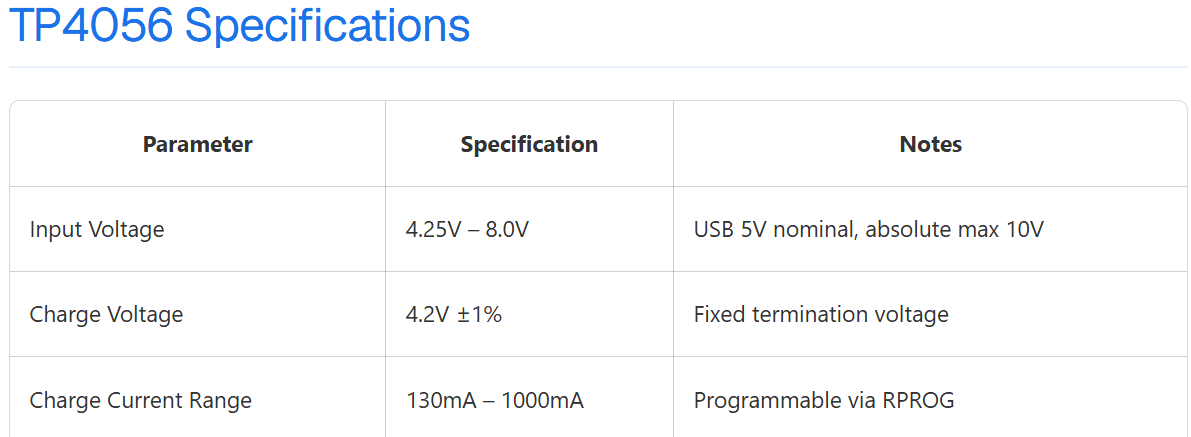
I always consult Gemini before doing anything, and it mentioned about not using the TP4056 directly with the LIPO battery.
 Industrial Monitor Direct
It so happens by default, now my charging current would be 1A, which will definitely burn up the LIPO. So now, and I hate this because I think I don't have the right apparatus for de-soldering a SMD on the TP4056, specifically R3 or RPORG as mentioned (1.2kOhm) to something more.
The standard formula for calculating the value of R_prog is 1000V/I_charge. The best sweet spot is charging the battery at a 1C charging rate, therefore around 0.4A, or at 0.7C. The best resistor to choose from is between 3-5kOhm.